Saturday, June 18, 2011

Gibraltar: It's All About the Rock!

Except for the day being overcast and rainy, which spoiled many possibly incredible photographs, Gibraltar was a wonderful entry into Europe from Africa. Karen, our guide, should be elected "Best Tour Guide Ever." This was not just our opinion but the decision of Richard, the destination port lecturer who served as our tour escort. He gave Karen his business card and told her to contact him for information on how she could become more involved with tours hosted by Princess in this area.

Karen had a gift for making history exciting as she acted all the roles of the major players in her one-woman play. A native of Plymouth, England, she has served as an officer in the Army for 10 years, much to the dismay of her father who was a Navy man. Then she met her husband who was in the Navy. While her father was delighted that she had finally found the Navy, he thought she had gone around the mountain to do so. One of her husband's tours of duty was in Gibraltar, which they loved so much that they decided to stay there. Having five sons, Karen said she was used to being ignored so nothing that we did would offend her. She did request that we act smarter than monkeys because she had met many people who did not.

According to Karen, Gibraltar was the biggest pebble in the world with the fifth highest density of population with 28,000 residents in the ninth smallest country on Earth. It is blessed by a good climate. Life there is relatively calm and safe. However, the rock gives its residents nothing with no commercial industry or exportable products. As the gateway to the Mediterranean Sea, Gibraltar is a fortress with stone walls. Twice a year, the government sponsors a ceremony of the keys that lock the fortress. When standing on Europa Point, the highest elevation of this country, one is on the top of the Rock of Gibraltar, unconsolidated sandstone and the Pillar of Hercules, the name derived from its role as guarding the entrance to the Strait of Gibraltar. On a clear morning, one can see Africa from Europa Point but our visit unfortunately did not occur on a sunny day.

Wow! If that information is not overwhelming, this fact will blow most people away--the Barbary Apes, who have become the symbol of Gibraltar, are really monkeys. Popular belief is that 250 apes or monkeys were brought there by the English as a source of food. All the monkeys are named and tagged, and we were warned not to feed them. Their favorite pastime seemed to be sitting on the roofs of vehicles. Legend has it that as long as the apes, or monkeys, remain in Gibraltar, the British will keep the rock.

The highlight of any tour of Gibraltar is taking the cable car up the rock to stop half way up to commune with the monkeys and then arrive at the top for a walk through the tunnels. The construction of the tunnels started in 1779 when the British, who had stole the rock from the Spanish but brought their own weather with them, were tied up with the pesky revolutionaries in the American colonies so Spain decided to take back the rock in what became known as the Great Siege. Even though Gibraltar was cut off from the outside world and the soldiers were starving, the general decided that they must set up a cannon to defend the rock so the country go out with dignity. The only way to accomplish that task was to build a tunnel through the rock. While the malnourished soldiers could only work on the tunnels for one-half hour shifts, the enemy saw where the tunnel was going in 1783 and accepted defeat. But George Augustus Elliott wanted to continue the tunnel until the rock was defended. Rather than continuing straight across to the final point, an engineer suggested that the tunnel be dug downhill so that the cannon would be placed as if in the eraser of a pencil rather than on top. Score a big victory for Gibraltar.

While the Great Siege accounted for many of the tunnels, Gibraltar's role in World War II claimed the rest. In 1940 Spain, Gibraltar's only friend, was neutral. If the Nazi could capture Gibraltar, they could strangle all the Mediterranean and the English would starve. In Operation Felix, Hitler, who according to Karen was a mommy's boy who did not study history so history repeated itself, tried to get in bed with Franco but Franco maintained that Spain was a neutral country so Hitler decided that Germany did not need Gibraltar and would head east, the same way Napoleon did. If that strategy did not work for Napoleon, why should it work for Hitler? Big mistake! The United States entered the war in 1941. In 1942, the Allied soldiers relocated the citizens of Gibraltar and started to dig a village in the rock with 10,000 soldiers who could live in the rock and work three shifts under the Royal Engineers to complete 34 miles of tunnels with offices, barracks and a hospital. Gibraltar became the biggest air raid shelter in the world. As Eisenhower stated, "It's not the size of a dog in a fight that counts. It's the size of fight in the dog." Ten years ago, Operation Tracer was uncovered in which six volunteers were to be sealed in a cave to operate an observation post to watch the traffic moving in and out of the Mediterranean Sea. If the Germans were not defeated during the first year after Operation Tracer began, those volunteers would never leave the cave.

We only wish we could explain all the history of Gibraltar as our firecracker of a tour guide could. Karen even told us that the monkeys were under such stress during World War II that they demonstrated their stress by not reproducing. Churchill brought in other monkeys to keep up the population. Her brief early history of Gibraltar started with the Arabs who inhabited the area for 750 years. Then came the Spanish. But if one studies Spain, the screaming conclusion is that Spain was once an Arab country. In one generation, Queen Isabella moved Gibraltar from being an Arabic country to being a Catholic power. Then came the British. But history is layered. The victors often tried to wipe out the previous power but if one dug deep enough, the layers would be evident. In the 1920s, an Egyptian mummy was found in the bay. In 1948, the skull of a Neanderthal was discovered in a cave. It had to be assumed that the species had no where else to go in a desperate attempt to survive.

After our history lesson and a tour of the museum, we drove across the runway of the airport to the border crossing station from Spain, our first glimpse of a country that was high on our list of countries we wanted to visit. Traffic would be stopped if a plane is trying to take off or land on the world's fifth most extreme landing strip. To cross the border into Spain, one needed a passport, which was not in our possession but we had no real need to do so because we would be in Barcelona on Tuesday. Many people commute daily from Spain to work in the gift shops and restaurants.

After our tour, we walked along the winding main street, where the cultural mix was evident with women in full Arabic dress, British officers and Spanish speaking merchants. We engaged in Ken's favorite type of shopping, window shopping, because many of the stores were closed or closed at 5 p.m. because it was Sunday. All along the street, we engaged in conversations with fellow passengers heading back to the Pacific Princess. On our way back, Nathaniel, one of the ship's dancers directed us to a local grocery store where Ken purchased enough beer to last him through the remainder of the cruise. So all was right with the world.

Thursday, June 16, 2011

We'll remember Morocco "As Time Goes By"

When we would arrive in Morocco on Saturday, we planned to take the ship's day-long tour (8 a.m. to 8 p.m.) to Marrakech. On Thursday night after dinner when Ken was able to connect to the Internet, he announced that a bombing that killed at least 15 people had occurred in a popular restaurant frequented by tourists in Marrakech. Sara commented that Princess would soon be sending a letter stating that the headquarters was accessing the situation and our chances of visiting the city were slim. Immediately after the words were out of her mouth, a letter was slipped under our stateroom door stating that Princess had the situation under consideration and would act in the best interest of the passengers. On Friday morning, a second letter informed us that the trip to Marrakech had been canceled. So we decided to sign-up for the Best of Casablanca and Rabat tour.

Of the three buses provided by Princess, we felt fortunate to have Niema, the only woman, as our tour guide. Passengers on the other two buses thought the male tour guides were very arrogant. Niema had a great sense of humor as demonstrated in her introducing yourself and the tour in Arabic. When she saw our puzzled faces, she asked, "What? You don't speak Arabic?" To much laughter, she announced that lunch that day would be at McDonald's, the American Embassy. She and her 11- and 14-year-old daughters like McDonald's for both the food and the clean restrooms. McDonald's chose Casablanca as the site for its first restaurant built in an Arab country. Someday that McDonald's may become a national monument. During the day, she kept mentioning how far women had come in Morocco and how things had changed. Perhaps as Shakespeare so aptly stated, "The lady doest protest too much."

Morocco is considered by many experts to be part of the Middle East with its dominant religion being Islam. Niema reminded us of the five pillars of Islam (one god, prayer, observation of Ramadan, alms for the poor and pilgrimage to Mecca at least once in a lifetime) and pointed out that all minarets in Morocco are square with one of the four corners facing Mecca and five or three balls--five for the pillars of Islam and three for the major religions of Islam, Judaism and Christianity because Morocco is a country of tolerance.

From 1912 to 1956, Morocco was a French protectorate and benefited from greatly expanded education, communication and public welfare. When Germany defeated France in 1940, Morocco was officially neutral but under strong German influence. This unusual diplomatic limbo provided the setting for the movie Casablanca with Bogie and Bacall based on the genuine espionage and intrigue in the city. When the French withdrew from Morocco, they restored full control to the monarchy. While the official language is Arabic, all school children learn French with the choice of a second language of English, German, Italian or Spanish.

Casablanca, the heart of Morocco, received its name from the countrymen who decided to occupy the city after it had been destroyed by Ferdinand of Portual in 1465. All that was left of the original city called Anfa was a small white house, thus the name Casablanca. Today, the city is quite modern but we were able to get a taste of the authentic Morocco at the old Medina, or market district. In the olive souk, the tubs of black, green and purple olives, which had soaked in water with lemon and salt for two to three weeks that was changed every week and were now ready to consume, gave us a sudden craving for that fruit early in the morning.

Niema pointed out a door knocker on one of the houses in the market district in the shape of the Hand of Fatima that brings luck to the owner or wearer. She pointed to her blue, yellow and green hand-shaped charm on her necklace, made of silver because silver is cheaper than gold and is a fashionable reminder of the Berber tribes, the original residents of Morocco. She also informed us that the men like to wear blue because it does not get as dirty as white and blue powder on the body acts as a sunblock and mosquito repellent. She pointed out the small windows of the houses, which are typical of Morocco because the jealous husbands did not want their wives to be seen from the streets. Niema commented that now the husbands carry a white flag asking only for peace and love, another sign of the liberation of Moroccan women.

In addition to the movie, the other two things that have made Casablanca famous all over the world are the Kasbah, an Arabic word for a fort that the city does not have, and the Hassan II Mosque, built by the current King to either inform tourists about the Islamic religion or to mollify the city's residents after selecting Rabat as his capital, or both. A mixture of modern and traditional architecture, the mosque, with two-thirds of the nine hectors of 2.5 acres each built over the water, was constructed in six years by three shifts of 5,000 workers working around the clock.

Before we entered, we put our shoes in plastic bags to help to keep the carpets clean. The beautiful handwoven carpets on the floors were made from natural colors of red from henna, blue from indigo, yellow from saffron and black from coal. The ornate metal ceiling was the equivalent of two sliding doors that could be opened. Through the glass windows, we could admire the Atlantic Ocean. The columns were made of granite and the floors of marble, 95 percent of which was imported from Italy. The Murano glass chandeliers were from Venice.

The mosque is only open for prayers. While 10,000 people can pray on the outdoor esplanade, 25,000 can pray inside. Every Friday, the practicing Muslims have time off from work between noon and two for prayer. Muslims pray five times a day at sunrise, mid-morning, noon, 3 p.m. and sunset. While prayers at home may last only two to five minutes, those at the mosque are much longer. Muslim kneel and put their foreheads on the floor to feel closer to Allah and ask him for the best things, like health and prosperity. People with bad knees can pray while sitting in a chair.

Muslims use the conveniences, or restrooms, to wash before prayers. Niema demonstrated the process, which she said sounded complicated but can be completed in a minute or two if one does it every day. Muslims do not have to wash five times a day if they had not broken absolution, which meant they had not used the toilet. After menstruation, a woman has to wait four to five days before praying and after giving birth, she cannot pray for 40 days in a mosque. Niema also explained in great detail the rituals that a bride in Morocco undertakes the night before her wedding that include relaxing massages, beautiful makeup and ornate henna tattoos.

After leaving the mosque, we stopped at the food market so that we could see the fresh fruits, vegetables, flowers, fish and lobsters. Alexi, probably the world's most traveled 6-year-old, delighted in touching the lobsters. Outside the market was a stall selling T-shirts for Rick's Cafe. Lunch included green tea that was boiled for two minutes before mint was added. After steeping for five minutes, the tea was poured back and forth between two glass pots to mix the ingredients. Sugar was optional. Niema warned us not to drink the tea in the morning before eating or we might suffer the consequences of gas.

On the drive between Casablanca and Rabat, we noted the rich agricultural district and the magnificent coast line with its beautiful beaches. Morocco suffered a drought between 1990 and 1996 with no rain at all so that people could not irrigate the land. Many of them emigrated to Europe or moved to the big cities. The Green Belt was the late king's idea to preserve the natural green lands.

Rabat is a walled city. The holes in the wall keep the wall from cracking during extremely hot weather. Across from the Royal Palace is the House of Fez, a mosque with a large esplanade for prayers. In the cemetery, the dead on buried with their right side facing Mecca. The good-looking guards at the palace wore handsome red uniforms with ivory caps while the military wore gray uniforms with green hats and the police sported gray uniforms with red hats. Greeters donned yellow slippers known as banana slippers. The king lives in Salee while his mother lives at the Royal Palace. The two blue fountains at the palace, which was built in the 18th century, were only filled when the king was visiting.

Our next stop was the Mausoleum of King Mohammed V with its design influenced by Napoleon's tomb at L'Invalides. When the king died in 1961, he was first buried at the Royal Palace while the mausoleum was completed. When the mausoleum was finished in 1971, his body was moved there. Now the men of the royal family are buried there while the women are buried at the palace. The gorgeous resting place rivals the Taj Mahal for its beauty. Niema told us to be sure to admire the ceiling with its stained glass and metal inlays. From a green marble railing with a metal front and a tile back, we looked down on the tombs of King Mohammed V, his younger son who died at age 43 from cancer and another male royal. On the mosque beside the mausoleum was an unfinished minaret. The king wanted it to be 77 meters high. When he died, it was only 45 meters. No one wanted to finish it because it was a tribute to the king the way it was. Seems like a good excuse not to spend any more money. The water sellers outside the mosque, who wore red hats and Mexican garb,did not really sell water any more but rather asked the visitors for $1 to take their photographs.

We then visited the Kasbah of the the Oudaias, a maze of narrow lanes and souks. The sky started to turn gray and threatened rain but the white buildings looked magnificent against the dark gray background. In the courtyard was a fountain where families and lovers enjoy coming to on the weekend to get away from the busy work week. At an area where we could purchase even more delicious green tea than what was served at the restaurant during lunch, Sara was befriended by a cat who curled up in her lap, making her even more homesick for our cat, Foxy. The rain that had been threatening all day turned into a downpour so Niema hurried us to our bus.

On the ride back to the ship, we passed a school for surfing with boogie boards. Sara wondered if the school in the white villa needed an instructor because she knew many former students who would have been on the Dean's List there. Niema told us more about the 48-year-old king who was really the King of the Poor People. He was the first king to introduce his wife, a commoner who is now 32-years-old, to the Moroccan people. While women suffered in the past after a divorce because they received nothing, the king has ensured that husbands now share their property with their wives. Also in the past, single mothers were rejected by some people. Now Princess Selma helps single mothers. Women are not obligated to cover their heads but many still do so out of respect. All of these are signs that things have changed for women in Morocco. Because Niema had endeared herself to us as a gracious and knowledgeable tour guide, we all hoped so for the sake of her and her daughters.

Thursday, June 9, 2011

Dakar: Africa's Answer to Richmond, Virginia

If you became tired by reading the description of the ill-fated tour of Accra, Ghana, please read on. This day was very good, even exceptional, except for the vendors, who must have been honor graduates of the school of harassment in Luxor, Egypt, the city which has earned the title of "Harassment Capital of the World," and the length of time it took for us to be served lunch. The tour was arranged by Pat, who promised not to take any photographs of police officers, buildings, monuments or in museums unless given written permission.

Dakar lies in one of the world's most strategic locations, being the most westerly point in Africa, making it the nearest point to Brazil in South America. You may ask why we will compare Dakar, Senegal, to Richmond, Virginia, where we lived for 25 years. Two major reasons: first, the city has incredibly beautiful sections and attractions while it also has areas that you would not want to go into after dark; and second, it is associated with the slave trade while Richmond was the Capital of the Confederacy that fought to continue slavery. Sara was involved in a slave walk as part of the Leadership Metro Richmond training program that reminded her of feelings of sorrow that she had when we saw the Gate of No Return on the Ile de Goree, the most impressive stop on our tour.

Before we took the ferry to the island, our guide gave us a city tour. We drove past the Presidential Palace, the Parliament and Independence Square, where the residents celebrate every holiday, including Easter that was yesterday. He told us that the lion was the emblem of Senegal. We visited the Catholic Cathedral, a large white church in art deco style, that offered magnificent stained glass windows and a painting of Christ's ascending to Heaven with people watching all around its interior dome. We passed the Great Mosque, built in Moroccan style, which is only open for prayers on Friday. Our guide informed us that the Muslims in Senegal are very liberal because men worship on one side while women worship on the other. In some Muslim countries, the women were not allowed in the mosques. When we were driving through Chinatown, our guide told us the Chinese were welcomed because they provided the residents with products from China to sell.

We learned we were visiting during the winter season so the temperature was in the 70s, coffee was made with pepper, malaria was a problem during the rainy season when too many mosquitoes appeared, voodoo from the West Coast of Africa was a popular religion and only 0.7 percent of the population has HIV-AIDs, a very low percentage. The unemployment rate was 38 percent, the crime rate was low, not many people smoke, and the country had virtually no problem with drugs. At the schools, which were on holiday on Easter Monday, all courses were taught in French. English was the second language with knowing English being a requirement for entrance to high school. We noticed a young girl, probably about 12, dancing on the porch of her home to what seemed to be a hip-hop beat. Her expression could have been seen anywhere in the world on a holiday from school or work.

We stopped at the Center Painting Gallery to discover the colorful Senegalese art of sand painting in which only natural colors of sand from different areas are used--24 different colors in all. That artist put glue on the section of the picture he wanted to cover and then drizzled the sand on by hand. The owner offered us four pictures for the price of three. When a fifth passenger inquired about a painting, we tried to convince him to give us a price break on five pictures, but he did not seem to understand our concept. We passed a statue that represents both World War I and World War II because all African troops debarked here for France.

We passed police officers exercising on the beach. Our guide commented, "Usually in Senegal, people are very thin but those are some fat policemen." Magic Land on the beach was a carnival environment that comes alive on Saturday night. Then we arrived at the port for the ferry to Ile de Goree, formerly known as Beer, where we were befriended by several women with small children who lived in Dakar but worked on the island. They made us promise we would come to their shops on the island after our tour.

The private guide we had on the island told us that 20 million blacks from all along the western coast of Africa left this island for the Americas while 6 million died there because of lack of medical treatment and dehydration. On the island was a statue of a man and woman who had been liberated that was donated by the government of Gaudalope where many of the slaves were transported. People from all the Americas come here as a pilgrimage to honor their ancestors.

The island had 28 slave houses, with the first having been built in 1536 and the last built by the Dutch in 1776, the one that we toured. Between 150 and 200 slaves lived in cells on the lower floor, separated by sex and age, for as long as three months before they were shipped to the Americas. These slaves were given a number, not a name, and often took or, rather, borrowed the name of their owners. The cell for the men was 2.6 by 2.6 meters where 15 to 20 men sat on the floor, chained to the walls. Men had to weigh at least 130 pounds or they were placed in a separate cell where they were fed to fatten them. The virgin girls, who were worth the most at a cost of four times more than married women, had a restroom facility inside the cell, while the other slaves were taken to the beach to relieve themselves. How could the masters define a virgin girl? She did not have sagging breasts. The Cellule des Recalcitrants for the slaves that misbehaved was where Nelson Mandela spent 20 minutes meditating when he visited the island after being elected the president of South Africa.

Sadness overcame us as we viewed the Doorway of No Return. The slaves were lined up one by one in the corridor awaiting the boat that would take them away from Africa forever. Some slaves tried to escape by jumping in the water but the guards who were there with guns shot them. The Holocaust lasted 12 years while slavery continued for more than 300 years. When Pope John Paul II visited the island, the residents told him, "We forgive but will never forget." How could the traders have lived upstairs with all the misery happening downstairs? The only explanation is that they truly believed that the blacks were people without a soul so they had to treat them as slaves and less than humans. It is so unimaginable that anyone could think that way.

Outside, our island guide pointed out the upside-down tree that is the symbol of Senegal. Because the inside is hollow, the residents buried the dead inside the tree, which only sprouts leaves during the rainy season. We also saw the cliffs where scenes from the movie The Guns of Navarone were filmed. Nearby was a Muslim mosque. We did not have to consider how to find the shops of the women whom we had met on the ferry because they found us and implored us to buy their necklaces and other items that they carried. When one woman on our tour purchased two necklaces, Sara stopped to help her fasten them around her neck. Our island guide reprimanded both women like they were naughty schoolgirls and shouted at the vendors to leave us alone. Two vendors approached Diana, one on each side, to tell her not to listen to our guide because he wanted to take us to a market where he would receive a commission. Probably true. It seemed as if everyone in Africa had their hand out for a bribe. There is actually a word for the greasing of the palm.

When we were getting ready to leave the island, the woman in the purple outfit whom Ken had talked to at the ferry terminal, ran after Sara with two necklaces she wanted her to buy. Sara, who usually bought items after determining what the lowest price the vendor would accept just to get the vendor to stop harassing her, did not want the necklaces so she said "No" very firmly. So Ken bought the two necklaces. Then the guide on the island approached each of us for a tip, sometimes several times.

After we took the ferry back to our van, our tour guide pointed out a large soccer stadium, which seats 60,000, that was a gift from the Chinese. And our country wonders why China has made such advances as a world power! We also were amazed by one of the most impressive statues we had ever seen, the Monument de la Renaissance Africane. The bronze statue, which was conceived by the president of Senegal, paid for by the government of the country and built by North Koreans, depicts one man, one woman and one child as the best number for a family. That way the man can provide for his family, the woman can have more freedom and the child can receive the best care.

We passed the Mosque of the Divinity, which was unique because it was built along the beach so the fishermen in their boats can come every Friday to pray. Our last stop was the handicraft market where the vendors seemed to hassle everyone but Bev, who actually purchased a beautiful beaded necklace. She told the rest of us that we need to learn to create a bubble around us so we did not have vendors harassing us. Bev also promised to take Ken shopping on our next port in Africa, Casablanca, to teach him how to do it.

Sara's new criteria for judging how much she enjoyed a port now involved whether we ended the tour without a policeman boarding our bus or van to drag off a passenger for taking illegal pictures. According to these standards, this port would receive a "good" rating. The sites that we saw and the information we learned earned it an "outstanding" rating.

Accra: A Tour Cursed From Beginning to End

Being cursed did not mean that everything on the tour was bad. Many things were very good but, overall, this day had more than its fair share of setbacks. Before coming on the cruise, Richard and Joan, our leaders on Cruise Critic, had set up a private tour in Ghana for 12 to 14 people. So many people wanted to join them that they tried to be nice and arranged for two more vans. Richard printed off a list for everyone of what to expect on the tour, including what sights we would see, that no lunch was scheduled and that people should bring their own water and snacks. He also asked Pat and Sara to serve as tour group leaders on Vans 2 and 3. Because we had crossed the equator recently and we were heading inland to the capital city of Accra, he assumed that people would know it would be hot. Unfortunately, it seemed that many people did not read Richard's carefully prepared outline and that no one could cope with the 110 degrees F. temperature. Lesson Number 1 turned out to be that if you are not making money off of an endeavor, keep your trip to one vehicle. Lesson Number 2 would be that you should not expect people to read and understand information while they are on vacation. You need to get in their faces and tell them face to face what to expect and then have them repeat it back to you. Lesson Number 3 would be that when the temperature is well over 100 degrees F., you should never expect anyone to be rational.

Sara was really excited about serving as a tour group leader because this role could be a possible third career for her after the corporate world and college teaching. Even people on the other vans who continued to be very friendly to her told her that she should not let this horrible first experience of being in charge color her opinion of this possible new career.

Because Tema is a huge, commercial port, the ship provided a shuttle to transport people to the gate, supposedly a 10-minute walk from the dock. The shuttles were small and part of our group of 36 were ushered to a second shuttle. While the first shuttle took off, the second shuttle waited at the dock. After 10 minutes, we asked if we could leave but were told that our shuttle had to wait until the first one returned. We waited for almost 30 minutes before leaving for the gate, which we learned was more like a 15-minute ride away. Lesson Number 4 is don't always believe the literature a cruise ship or a tour operator provides. Even after everyone was seated in their assigned vans, we did not take off. The tour company wanted its money and informed us it had to go to a money changer to get it changed. The temperature kept rising, the air conditioning on the vans turned out to be anemic, if not nonexistent, and several people had to get off the vans because they were getting grossly overheated. Would this tour ever begin?

Once we did pull out onto the incredibly crowded highway, the first site we saw was a shanty town quickly constructed for the workers who had built the harbor. After they had finished the project, many of the workers had decided not to go back to their homelands but remained in Tema, making this shanty town the biggest slum in the area. The unemployment rate is more than 55 percent so everyone makes a living anyway possible. The emergence of technology has created some new jobs but not nearly enough. Along the road were many unfinished homes. Most of the foundations were concrete, which is expensive, so people would stop building until they could earn more money to continue.

Someone noted that we were driving on the right side of the road, which was odd in a country that had been a British colony. Our guide Nii informed us that when the country was under a military government in 1972, that government had changed the driving lanes from left to right. Nii also informed Sara that he was the only guide for all three vans so he would be switching to another van when we made a rest stop. When Sara asked the driver if he spoke English, he answered, "Very little," which really meant almost nothing. Lesson Number 5 was not to expect much in a third-world country that had only gained independence in the last half century. But why should we expect more because our country has been working at it for more than 200 years, and with what was happening with inflation, unemployment, a staggering national debt, skyrocketing prices for gasoline and a budget that saw far more spending than saving, has not gotten it right yet. Lesson Number 6 about dealing with only one tour guide for three vans and drivers who did not speak English was get everything that you want from a tour in writing. However, we were not sure that a written contract would have guaranteed us anything better with Ghana Welcome Tours.

Our first stop was the National Museum about the life, culture and history of Ghana. While the museum's guide tried his best to inform us about the exhibits, what impressed our group most was the good prices on authentic African art that were fixed. No one wanted to go upstairs with the guide when they could buy crafts with no one harassing them like the vendors on the streets. We even had a difficult time getting the tour group leaders out of the gift shop when our tour ended. As we were leaving, a group of Chinese tourists entered for their tour in Chinese.

As we drove to the next stop, which we had no idea what it was, we noted that the women carrying baskets on their heads had fashioned a device from twisted scarves that they wore underneath the baskets to make it easier to balance them. Now that we were in the city, traffic was much worse. People walking along the sidewalk were making better time than our van. The driver told Sara that Friday was the worst day for traffic, but this was Thursday. Being in the front seat next to the driver, Sara witnessed up-close and personal when two vehicles from either side tried to merge into our lane. No wonder so many cars and vans sported huge dents and scrapes! A billboard that impressed us touted, "Justice is not for sale. Resist from taking or making bribes." We needed this sign in the United States.

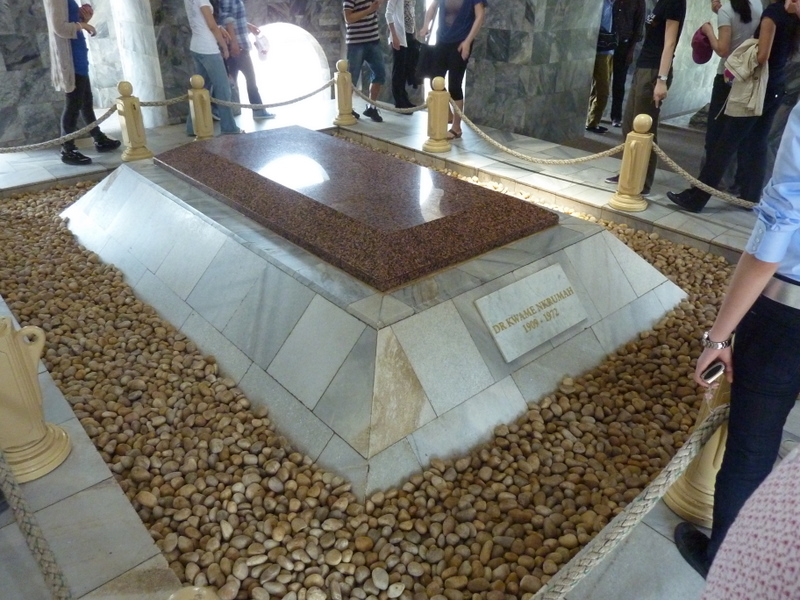
When we finally arrived at the second stop, the Kwanie Nkrumah Memorial, where the first president of the country was buried, we learned that the Chinese tourists who were behind us at the museum had beat us to this stop and had already started their tour. We later learned that the group had paid for a police escort. Lesson Number 7 was do not always believe what a country touts on its billboards and in publicity. Money talks, even with the police who are government workers.

The first statue we saw was the separate body and head of the first president. Before being moved to this location, the statue stood in front of the old Parliament House. During a coup d'etat on February 24, 1966, a mob had vandalized it. For Sara, this was what should happen to passengers who do not listen to their group leaders. We had learned about the fate of the first president, who ruled for six years as president, from one of our fellow passengers on the ship, Ronni, who had lived in Ghana from 1967 to 1970 while her husband had a contract as a trainer with Kaiser, that Kwanie Nkrumah was a dictator whom most of the people hated but for some unknown reason was now canonized by the same country that had overthrown and exiled him.

The major monument in the park resembled the trunk of a stylized tree that represented the unfinished business of the first president who wanted to free all of Africa, probably to be jewels in the crown of his dictatorship. Growing in the memorial park were trees planted by the leaders of other countries who had visited Accra. The best thing about the museum on the grounds, where we could not take photographs, was the air conditioning. The first president, who lived from 1909 to 1972 when he died of prostrate cancer, was married to an Egyptian, Madam Fathia. He also wrote 14 books (the most notable being Africa Must Unite) and numerous pamphlets after he had received degrees from several British and American universities, including the University of Pennsylvania. How did he have the time to write so extensively while being imprisoned and then governing a country, when we cannot seem to keep our blog up to date? At the museum, several people on our van admonished Sara that we needed to change the itinerary of our tour so we could go to places that were not duplicates of sites we had seen in other countries. Lesson Number 8 was to realize that people whom you thought respected you could rise up against you it they did not get their own way.

On our drive to the artists' market, which was clearly presented as a stop on the information sheet that Richard had provided everyone, we passed a funeral in which the mourners were wearing white. Fortunately, Nii was riding in our van so he told us that if the deceased is 70 or more, the attendees wear white because that person has fulfilled God's promise of three score and 10 years. If the dearly departed is 50 or more, the mourners wear brown, and if the newly dead is between 20 and 50, they dress in red. Outside of Accra, mourners dressed in black. We passed Independence Square, which is the second largest open space after Tianaman Square in Beijing and a billboard proclaiming "A New Accra for a Better Ghana."

When we arrived at the market, the passengers on our van voted to spend only one-half hour there rather than the allotted hour. Even Richard said this was fine but he did not consult with our tour guide, drivers or the young Dutchman who managed the tour company who had been following us in a taxi. When we returned to the van after being harassed by the vendors and buying more things than we wanted to buy just to get out of their shops (TIP: Never get taken alone to the back of a store by the owner because you will not be able to escape the store without spending more money), we could not find one of the passengers. Finally, the Dutchman told us that she was in another van and he would be riding with us. When he disappeared, Sara, trying to be a good tour leader, searched the other two vans for the missing passenger because she did not want to leave anyone behind. After being at the market for more than an hour because four passengers on one of the other vans had decided to eat lunch at the only diner in the market, the Dutchman returned to our van with the message we could leave. But still no lost passenger. Lesson Number 9 was that even if you had booked and paid for a tour, do not assume that you are in charge because the non-English speaking drivers in Vans 2 and 3 may not know their way around the city, and they need to follow the first van. Also, we later learned that the manager of the company had loaned his taxi to our missing passenger because she had spent the whole tour complaining and wanted to go back to the ship immediately.

Sara told the tour guide that everyone would be happier if we stopped at a place where we could buy sodas or other drinks. He agreed and informed the other vans to follow him. He had our driver stop at an Italian restaurant in a section of the city that he said was known for its restaurants and night spots. After we all used the restrooms there, we learned from the waitress that the place did not accept American dollars. Why had the guide chosen this establishment? Lesson Number 10 was do not be an arrogant American who thinks that every other country in the world should accept our currency. Does the United States honor theirs? Also, make clear to your guide exactly what you want and how you want to pay for it.

At this point on our ill-fated trip, everyone in Van 2 wanted to tour the W.E.B. Dubois House while the passengers on Vans 1 and 3 were divided. To Sara's disappointment, only she, Ken and another passenger wanted to continue the tour with the remainder wanting to return immediately to the ship and put an end to their misery. To add insult to injury, Ken would have joined the majority if Sara had not been the tour leader. So Sara jumped ship and abdicated her leadership on Van 3 to join Van 1 on the continuation of the tour.

Actually, this was the best stop. Dubois, the first black Ph.D. graduate of Harvard University and the founder of the NAACP, had been a mentor of the first president who invited him to come to Ghana at the age of 92 to write the Encyclopedia Africana. Dubois' trip was postponed for a year because the United States would not provide him with a Visa to return, thinking he might be a Communist. At the age of 93, he and his second wife settled into the house where he supervised the research for the set of eight volumes until he died at age 95. As a friend of the president, he was given a state funeral. The tour was wonderful but it kept getting extended and extended and extended while Van 2, which had left the restaurant before ours, failed to arrive. After we had been shown the original bathroom in the home and learned what all the symbols on the benches circling the burial place of the ashes of Dubois and his wife meant, we inquired about where the other passengers were and noticed that our van was missing. We were informed that one of the passengers on the second van had raised her camera to take a photograph of the American Embassy, the largest embassy we had ever seen, before noticing the "No Photography" signs and put the camera down without snapping the picture. However, a Ghana policeman noticed the camera and forced the van to stop, taking the passenger off the van in the direction of the American Embassy. The manager of the company had contacted our driver to bring our van to the embassy. Lesson Number 11: Do not take photographs of any building or police officers unless your guide tell you that you can.

While we were concerned about our shipmate, we were equally dismayed that we were vanless and had left most of our things on our van. The owner of the tour company finally appeared with a different van and driver who promised us that we would get back to the ship before all passengers were required to be aboard. Staying an extra night in Ghana and trying to make airline reservations to the next port of Dakar were not what we wanted to do. On the way back, we learned that Pat was the one with the camera who was marched off the bus. After the owner of the company had explained that she and her group were on a cruise ship and needed to return to the port immediately, and Pat showed a copy of her passport proclaiming that her blood ran red, white and blue, she and the manager were finally released. So everything should have been fine, right? Are you kidding? It turned out that the driver of Van 2 had started an argument with another policeman who demanded that he show his driver's license. He vocally refused very loudly and very long (perhaps he did not have a license) and was marched away. Because the manager did not have a Ghana driver's license, he sent for our van and engaged a fourth van to take us back to the port.

We drove along a paved, and then unpaved, extremely bumpy road along the shore, which was selected as an alternate route because of the traffic jams on the highway that we had used when we came from the port to the city. Sights not to be missed were the people standing along the road and on the median trying to sell everything from toilet paper to food to the people in the vehicles, the miles and miles of vendor stands along the road, the juxtaposition of the military firing range on the beach near a Peacekeeping Center and the shops that sold Fantasy Coffins of Pa Joe and Pa Willie in the any shape one desires. Ken said he wanted to be buried in a casket shaped like a beer can so he will know that he "has died and gone to Heaven." Someone suggested that it would be cheaper to cremate him and put his ashes in an empty beer can. Custom caskets may be an idea for a new business in the United States.

When we arrived back at the gate to the port, we learned that all our belongings were waiting for us. Sara was one of the last passengers off the van because she was sitting in the back, not in front by the driver, and had not had to use her newly acquired skill of jumping up onto the seat. Instead, she had to put down the jump seat in front of her. When another passenger tried to help her, she had her left hand in the wrong place, and the bar snapped on her hand. It's a good thing she is right handed because her left hand was badly bruised and still hurt sevem days later. Lesson Number 12 was that no matter how bad things have been and you think that everything is finally over, things can still get worse.

When we boarded the shuttle to the ship, we were greeted by the passengers on Van 3 who told us they had been waiting for us. Actually, they had taken the major highway, been delayed and had just got back minutes before those of us on the extended tour of the Dubois House returned. The passengers who were detained at the American Embassy made it back before either of the other two original vans. Their van got behind a bus carrying passengers on a ship's tour that had a police escort so they told the driver to follow that bus. The traffic had come to a standstill when a policeman escorting the bus got out, motioned for the traffic to move back, and then directed the bus to cross over the median strip and drive on the wrong side of the road. The van followed the directions.

Richard, the organizer of our tour, has determined to develop a questionnaire to hand-select who will be on any of his future private tours including questions on how long passengers can go without food and drink in extreme heat. Sara has decided that she will probably not plan a third career as a tour guide or travel agent. Instead, she will develop a training course for tour guides and travel agencies in developing countries so that they are prepared to handle the worst. Punxsutawney Phil refused to come out of his make-shift burrow in Sara's purse during the entire tour and was rejoicing when the Pacific Princess sailed away.

Togo: Africa in Miniature and Hot, Hot, Hot!

How does one start off a day not sure of ever having heard of the country Togo and end the day thinking of it as one of the best places to visit ever? Yes, it has to be the supernatural powers of the Pacific Princess. Africa in Miniature comes from the description of Togo by our tour guides Joseph and Kamal who were very enthusiastic about their mission to provide us with an overview of their homeland. Because we crossed the equator the day before, you can probably guess why the adjective "hot" was appropriate. Between the heat and the humidity, the camera lens kept fogging over.

Togo means the other side of the river. Following Germany's defeat in World War I, the country was divided into two territories, one British and the other French. When the French part officially gained its independence under a dictator on April 22, 1960, its complete name became the Togolese Republic. (Independence was declared in 1958 but was postponed for two years due to a lack of infrastructure.) The official language is French because "we suffered under the French colonization" according to Joseph, the major religion is Voodoo, coconuts have replaced slaves as the major export, June 1 is the day that every citizen is to plant a tree, the annual per capita income is less than $500, the Fetish market is a traditional drug store, the rate of HIV-AIDs is between 20 and 30 percent, smoked fish is eaten almost everyday, and chewing sticks made from the alome tree are the basis for the capital's name of Lome.

Both our guides on this tour sponsored by the ship through Alba Travel Services had college degrees in literature so they could speak English, qualifying them to be teachers or tour guides. The unemployment rate is through the roof, and the competition for jobs is fierce. Kamal pointed out the large number of motorcycles that provide the fastest transportation and are often driven by people with college education who cannot find jobs in their field and are earning their livings by transporting customers on their motorcycles. The best way to make ends meet is to open a business. The first thing people do when they get a job in Togo is to acquire a loan and start to build a house because not owning a house is a shame. The house is built bit by bit as the owners acquire the money necessary to complete the project. Everyone seems to own or rent a space for a garden.

We passed a memorial depicting a white woman and a black woman holding hands to symbolize the friendship between whites and blacks. Our guide informed us that women have been very fierce in the fighting for the country. The first village where we stopped outside of Lome was Aqraba (???) where the chief welcomed us with libations by pouring water on the ground to let us know we should make this place our home. Having your photograph taken with the chief was an option. Then we walked to the wooden home of the Dutch slave trader and saw where the slaves had to squat in the lower level until the trader had the number desired to send on a ship abroad.

Then we went to the Fisherman's Village to witness the temporary housing that the families build from anything available from nature. The residents have better houses in their hometowns but they use these "informal" shelters while the fisherman go out to sea for a week or two at a time. These residents believe in polygamy because they need many hands available to do their business. Weaving the nets by hand and fishing are very hard work. We noted that the water in the lagoon had a yellowish cast because of the phosphates.

Our next stop was the village of Glidji to meet the priests who are the traditional healers. Every year in September, the village raises a stone to mark the new year for the people. The color of the stone symbolized the message for the new year: green for a rich harvest, red for hardship, white for peace and blue for flooding. The stone was whitish so the village should be peaceful. The priests and priestesses are selected by the gods. with Mama Koley being the queen of them all. The symbol of the eye meant the gods were watching us and would chase away evil spirits. The people believe that are gods are near us and their ancestors are never far from us. The cemetery was next to the village. While visitors were required to remove their shoes on the holy ground, we were permitted to keep ours on. Out guides told us that while the cities are for everyone, the village that is a person's hometown is only for them.

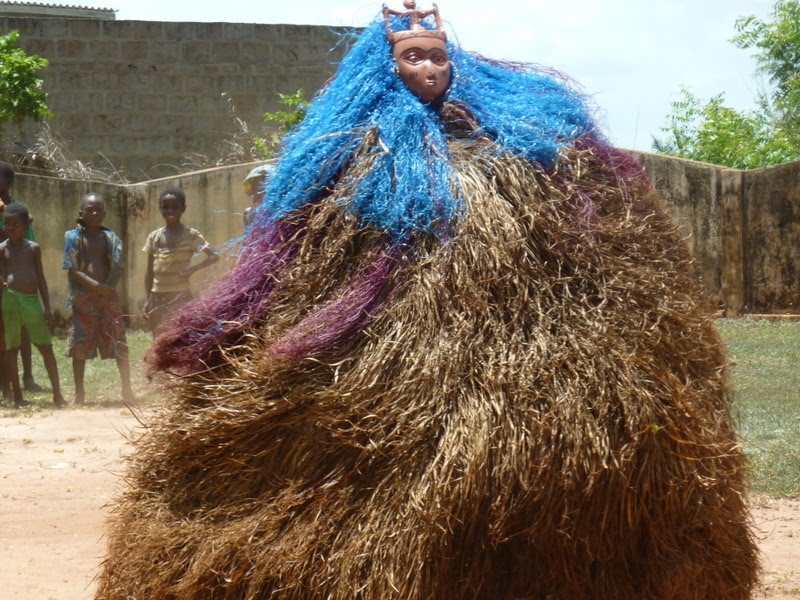
Our driver kept going into the country where we finally came to the Village of Wonders and Miracles where we would experience the Zangebeto Dance of the Night Watch Men. Our guides informed us that if we were lucky, we would see wonders. The man dressed in red was the chief commander of the entire ceremony. Once we were all seated along the sides of an open area, the native children came up behind us to watch with their wide eyes of wonder. (They already had an idea of what they would witness. We had no idea of what wonders we should expect.) They all seemed healthy and had good teeth. They were so cute!

The ceremony started with traditional dancers. Then these whirling haystacks of turquoise, magenta and gold straw entered and began twirling. The final bundle of gold straw straw, which wore a mask underneath its cranberry and turquoise straw hair. wiggled and shook to the beat. These haystacks could have been Africa's version of the roomba sweepers lifting up the leaves, twigs and sand. Men who acted as handlers for the haystacks lifted up the bundles or tipped them over to show the mesmerized viewers that there were little motorized statues underneath or nothing at all. Under the magenta stack was a miniature magenta stack that stood upright and then slumped down. The natives watered the tiny bundle so it would grow. Then the handlers placed the bundles in upright position so the haystacks could whirl around and walk back to the staging area. The children surrounded the bundles that started to chase them, scaring the children away. This was part of the voodoo ceremony. All this time, the handlers talked to the haystacks as if giving them directions. If one believes in spirits, the bundles may have been moved by ancestors of the residents, who were never far from their living relatives.

When the program was over and we started to board the bus, one passenger gave his empty water bottle to a delighted child. The children indicated that they wanted more so we began gathering the bottles and passing them to our guides to hand to the children. What started out as fun quickly turned ugly when the children started to fight over them and grab them out of each others' hands. Our guides yelled to the driver to flee the area quickly. It is difficult for us who have so much to understand the lives of those who have so little. We wanted to do what we could to make them happy but had no idea what the consequences of our actions could mean.

The form of voodoo that we had seen had been very mild according to what the ship tours had warned us. Our guides told us that extreme voodoo ceremonies often put people into a trance that may take one to two hours depending on the message that the voodoo ceremony wants to get across. We were still looking for the sacrifices of live chickens and goats. Our guide also informed us that security in the villages was not accomplished by police but by voodoo.

Other interesting things that we learned included that the children in the villages not only belong to their parents but also to the relatives in the family and then to the community at large. Children are named after the day of the week on which they are born and also may be named after an important event. When the baby is to be named, the eldest auntie carrys it across the floor while water is poured from the roof. The baby is told that struggles would be in life but that so would love.

We had a buffet lunch for which "you do not have to pay," at a beach resort and were entertained by a folkloric show that boasted new dances. Sara and some friends walked across the road to what Sara proclaimed was a "shopping emporium" where she could not stop buying African made products. Actually, it was only one vendor's stall. On our way back to the ship, we stopped at an arts and crafts market where Ginger advised Sara to purchase a batik T-shirt. Ken could not believe that she had spent that much for a T-shirt but Sara stated that her new fashion consultant had made her buy it. She gave the T-shirt to her graduate school roommate and maid of honor, Betsy.

The only negative aspect of the day was when we arrived back at the gate to the port, and one of the policemen at the gate thought that a passenger on our bus had take a picture of him. The guard on our bus told the policeman that she had no such picture on her camera but that did not stop the policeman from marching her and her camera off the bus to the guard station and then satisfying himself that she had not take a photograph. When she was back on board, our guides asked us to forgive the policemen because they are not highly educated. For a country that promotes tourism, it should train its police officers how to behave.

But we could not let a minor incident ruin our trip (except for the woman marched off the bus). Everything considered, our day was one of wonder and miracles!

Tuesday, April 26, 2011

Cape Town: Live it! Love it!

Live it! Love it! is the tourist slogan for Cape Town. However, we think that anyone who had ever visited Cape Town will agree that it deserves its title as one of the world's most beautiful and livable cities. If we overuse superlatives in this entry, please forgive us but remember we really think it is one of the most wonderful cities we have ever visited.

We arranged to meet Joe and Ginger to take the Hop-on, Hope-off Bus. Before boarding we walked over to the museum for Robbins Island for Joe to buy a ticket for the next day's trip to where Nelson Mandela has been held prisoner for 27 years during apartheid. This island was known as the "University," because a stint there put a prisoner in contact with Mandela and so many other notables in the country's fight for freedom. After we bought our tickets for both the Blue and Red Lines, we ran into Jean-Guy and Diana, Joe and Ginger's friendly companions from Ankgor Wat and ours from India. An incredible six-some. Okay, the first superlative--the commentary on this hop-on, hop-off bus has to be the best ever. We learned so much.

First, our commentator informed us that the port where the ship docked was the Victoria and Alfred, not Albert, Waterfront. Alfred, the queen and prince's second son transported the first batch of stones to the port to fill in the bay. We marveled at a highway near downtown that just stops because people protested it would destroy the important cultural heritage. Its remnants remain as a monument to the city planners in the 1960s and 1970s. Today, this unfinished highway is used to film stunts for advertisements and movies. We were equally impressed with the International Conference Center that was opened in 2003 to entice conferences to this spectacular city. Joe spotted a sign for Rotary International that made him want to visit the chapter because he was from the birthplace of the service club--Toledo, Ohio. The other sign that we all appreciated was "Feeding baboons is deeply unwise," a quote that can be used for many activities.
Cape Town also boasts the hospital in which Christian Bernard performed the world's first heart transplant and the University of Cape Town, the oldest university in South Africa. It was the site of lively protests during the height of demonstrations against apartheid in the 1980s. Cecil Rhodes, one of the major figures in Cape Town, who was a confirmed bachelor but a magnet for attractive women, was the impetus for Rhodes Scholarships. Any recipient from South Africa must be committed to working for the betterment of the country.

Then we reached the point on the bus where we had to decide which of two stops we should get off the bus--we did not have time to do both--the Kirstenbosch, considered one of the finest botanical gardens in the world, or the Constantia Wine Tour at the oldest vineyard in South Africa. By a unanimous vote, we all departed the bus for the wine tour that had opened in January 2011. After the wine tasting and the walk around the winery, we all agreed that we had made the right choice. Friends who toured the gardens later informed us that fall was not the best season for the flora.

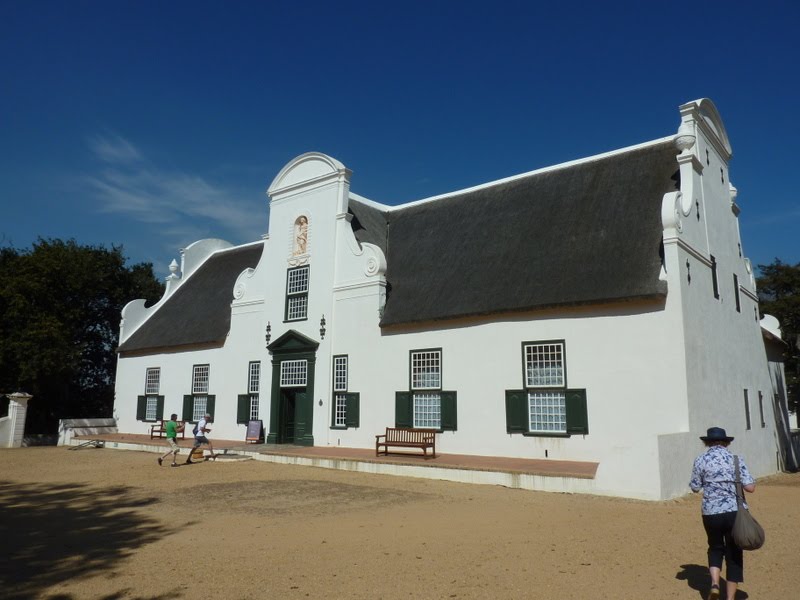
Simon Vander Stel created his beloved Groot Constantia Wine Estate in 1685, where visitors are only a "cork pop away" from Heaven. The estate was built with slave labor and had been modified lavishly by its subsequent owners. One-half of the land was under vines, with 70 percent being used for red wine and 30 percent for white wine. Our hostess was very generous when she poured the wine for tasting. In fact, she joined in the drinking of the wine with us and opened a bottle of one of the most expensive wines that was clearly marked "not for wine tasting" for us to enjoy. We six were joined by three men from England, and thanks to Ginger, the women each had their photograph taken with one of these men who coordinated with us in color--the most impressive being the Englishman wearing a lime green shirt that matched Ginger's scarf from Singapore, which Joe remembered as a "three-scarf day."

After we rejoined the regular Blue Mini Peninsula Tour, the commentary pointed out a "Shanty Town" where Nate Milton, an Irishman, had built brick houses for the shanty dwellers. Unfortunately, Cape Town, like much of Africa, has a huge problem with unemployment and poverty.

In complete contrast, the remainder of the tour took us along Beach Road with South Africa's best beaches, which we will summarize concisely. The waterfront has been transformed in the last 20 years but the key to success for the city is that it is a working harbor:

Hout Bay: With the slogan is "Work is for people who can't surf," this beach with 20-meter waves (the size of a 10-story building) sponsors the world's most famous surfers in May through August. The water can change from smooth as glass to something that looks like a giant washing machine churning round and round. For these wave chargers, it's "just another day at the office."

Camps Beach: This is the Venice Beach of Cape Town, a place to see and be seen by the rich and famous.

Clifton: This beautiful strand is Cape Town's most valuable property. Smart, stylish people hang out there.

Bantry Bay, Sea Point, Three Anchor Bay: These are some of Cape Town's most popular beaches. There are a beach for singles, a beach for models and weightlifters, a beach for surfers and a beach for families.

Mouille Point: The red- and white-striped, square-shaped lighthouse is the oldest in South Africa. Numerous ships have sunk off its coast.

Once we completed the Blue Tour, we transferred to the Red City Tour with our ultimate destination being Table Mountain. On the way, we passed the Old Slave Lodge, where slaves who worked in the city were locked up at night, and drove through District Six, well known for the role that it played in apartheid. In 1951, South Africa banned marriage between the races, based on the concept the people of different colors could not live together. In 1968, the bulldozers arrived in that section of the city to begin the grim task of demolishing the residents' homes before relocating 60,000 black people. Overnight, the social and economic structure of Cape Town changed. When apartheid was abolished in 1994, committees were formed to prevent the redevelopment of the area so that the grass and weeds remain as a monument to the inhumanity that was part of the movement. Today the white houses in the area belong to the first families who have moved back into District Six with the hope that these residents will breathe new live into the damaged neighborhood.

The commentator also pointed out the Castle of Good Hope, the oldest standing building in South Africa, which was built in the shape of a five-pointed star to defend the cape from the Dutch taking control of it. In its heyday, the Castle of Good Hope was the center of community life, boasting its own bakery and church. It was also used as a prison and place of torture so it has its fair share of ghosts. Today the castle houses a military museum. Another highlight was the Clock Tower of City Hall where in 1990, the world was able to hear the voice of Nelson Mandela after he was freed from Robbins Island after 27 years as a prisoner. Also on the route were Trafalgar Place, a flower market that is a Cape Town landmark; Strand Street that used to be beachfront property before the land was reclaimed; houses in the former slave quarters that were brightly painted because the slaved were restricted to drab-colored clothing; and the Italian Stone Pines that are a bone of contention because they are part of the national park, which some people claim should only sport indigenous plants.

Table Mountain is the heart of Cape Town and served as a symbol of hope and freedom to the prisoners on Robbins Island. More than 80,000 visitors take the Cableway to the top annually. The cable cars revolve so that all passenger can admire the 360 degree view. At the top, we smiled at the cute dassies, which is Dutch for badger, that hold claim to being the nearest relative to the elephants that are not extinct in the area, and took the short Dassie trail to obtain a panoramic view of the Cape Town area.

Then we returned to the waterfront, which was modeled after the waterfronts in Sydney and San Francisco, to consume three pitchers of beer among six people--Ginger, Joe, Jane, Michael, Sara and Ken. We got back to the boat in time to watch the African Folkloric Show before turning in. We had an early start the next day for our tour to the Cape of Good Hope.